
Whether Laos can persuade other governments in the region to sign up for a level SEZ playing field is questionable — despite the signing of the ASEAN community in Kuala Lumpur on Nov. 22, just hours before Malaysian Prime Minister Najib Razak ceded the chairmanship of ASEAN to Laos Prime Minister Thongsing Thammavong.
KUALA LUMPUR — Laos, as the incoming chair of the 2016 Association of Southeast Asian Nations, has urged member states to agree on a region-wide regime for Special Economic Zones, which have proliferated in recent years.
“We think that a framework for Special Economic Zones would be good to set up because we see that in each ASEAN member state, we develop different economic zones,” Laos Minister of Industry and Commerce Khemmani Pholsena told a business forum in Kuala Lumpur during the recent ASEAN summit.
Some SEZs have their own management teams and separate customs procedures — all in the name of making life easier for would-be foreign investors in poorer countries such as Cambodia and Myanmar, where infrastructure and rule of law do not measure up to more advanced economies such as Malaysia or Singapore.
Laos, the smallest economy in ASEAN and one of the poorest, has established two major SEZs in recent years. Among the foreign multinational corporations establishing operations in Laos are camera and lens manufacturer Nikon and carmaker Toyota.
“The government designates investment-promotion areas like SEZs where the quality of infrastructure is generally better and FDI-related regulations are more streamlined,” said Vanthana Nolintha, senior researcher at the National Economic Research Institute, a government research organization in the Lao capital, Vientiane.
What’s in a SEZ?
The pulling power of a particular SEZ can depend on external factors in a country — such as the size of the domestic market, labor costs — or ease of fitting a particular factory into a wider production network. This is especially so given that many products are put together after components have been manufactured separately at factories often scattered across different countries.
Countries set up SEZs to compete for investment — pitches based on an array of incentives that can include having lower taxes or longer land lease rights than those of a neighboring country. With dozens of SEZs across the region, all with their own rules, comparing the attractions of each can be difficult.
“SEZs are very popular across the region, with many kinds of SEZ and many variations in how successful they have proven,” said Jay Menon, who has researched SEZs for the Asian Development Bank.
Myanmar, for example, is pitching three major coastal SEZs as part of its strategy to pull in foreign investment in manufacturing as it tries to wean itself from reliance on natural resources extraction and exports.
Cambodia, in turn, has set up SEZs aimed at attracting Chinese investors and foreign garment makers, with other zones dedicated to casinos set up near the border with Thailand, where gambling is illegal.
Yasushi Ueki, an economist at the Economic Research Institute for ASEAN and East Asia, said that SEZs are key to attracting foreign investment into ASEAN’s poorer countries.
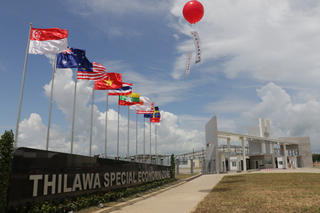
Photo to the left is the head office of the Thilawa SEZ, a half hour drive from Myanmar’s commercial capital Yangon, September 2015. (Photo by Keiichiro Asahara)
“SEZs play important roles in attracting FDI especially in Cambodia, Laos and Myanmar. In these countries, only SEZs can provide multinational corporations with hard infrastructure essential for machinery and other modern industries,” he said.
But ASEAN’s more developed economies are creating new SEZs as well. Thailand is setting up a range of such zones along its borders with Cambodia, Laos, Malaysia and Myanmar. This is partly in the hope of attracting cheap labor, particularly from Cambodia and Myanmar — two countries that already have several million migrants in Thailand.
Indonesia, in an effort to draw more visitors to its vast archipelago, is backing new zones dedicated to tourism. Despite its size, diversity and natural attractions, Indonesia receives around half the number of visitors that flock to Malaysia and Thailand.
Build and they will come
Whether Laos can persuade other governments in the region to sign up for a level SEZ playing field is questionable — despite the signing of the ASEAN community in Kuala Lumpur on Nov. 22, just hours before Malaysian Prime Minister Najib Razak ceded the chairmanship of ASEAN to Laos Prime Minister Thongsing Thammavong.
“SEZs in Malaysia and the industrial estates in the eastern seaboard of Thailand are much more advanced than SEZs in CLMV [an abbreviation for Cambodia, Laos, Myanmar and Vietnam]. Therefore, to create a common set of rules might be difficult,” said Vanthana Nolintha.
Speaking at the same forum as Khemmani Pholsena, Malaysia Trade and Industry Minister Mustapa Mohamed said that ASEAN member states “have our own national priorities, national agendas.”
“We do things by consensus,” he said, discussing how ASEAN would move on with its next set of economic integration measures after the Dec. 31 launch of the ASEAN community agreement, which aims to create a tariff-free market and free movement of goods and services across the 10 member states of ASEAN and their combined population of 625 million.
Laos faces the challenge of persuading the other nine ASEAN members to agree a common set of rules in an area of fierce competition. Khemmani Pholsena said at the forum: “How we can make this legislation coherent for each other? We really think about that for next year.”
Appealing to the CEOs and entrepreneurs present, the minister said: “We would like support from the business and private sector community.”
On the downside, the generous tax and excise breaks offered to companies setting up in SEZs often undermine the already shaky revenue base for regional countries — money that could be used to develop infrastructure and social welfare systems.
An August 2015 report by the Organisation for Economic Co-operation and Development showed that 2013 tax-to-gross domestic product ratios in Indonesia, Malaysia and the Philippines ranged from 13.1% to 16.9% — well below the OECD average of 34.1%. The 2012 tax-to-GDP ratios for Cambodia, Laos and Thailand were 11.6%, 14.8% and 16.5% respectively, according to the World Bank.
“At the moment, it is a race to the bottom to outdo each other,” said Menon. “If they can harmonize incentives it would reduce the huge burden this places on fiscal resources, which in some cases are being sacrificed to attract MNCs.” - SIMON ROUGHNEEN, Asia regional correspondent, December 2, 2015
http://asia.nikkei.com/Politics-Economy/Policy-Politics/Laos-pitches-common-standard-for-Southeast-Asian-SEZs?page=2